
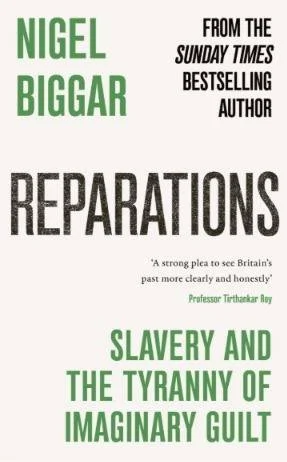
Featured book: Nigel Biggar, Reparations: Slavery and the Tyranny of Imaginary Guilt (London: Forum, an imprint of Swift Press, 2025; paperback 2026).
Lord Biggar, Emeritus Regius Professor of Moral Theology at Oxford, offers the most substantial recent case against slavery reparations. I discuss it in Section VII below.
Buy in the UK (paperback) · Buy in the US · Publisher's details
Introduction
On 25 March 2026 the General Assembly of the United Nations resolved, by 123 votes to three with 52 abstentions, that the transatlantic trafficking of Africans and their "racialised chattel enslavement" constituted "the gravest crime against humanity".¹ The United Kingdom abstained. Some five months later a delegation of the Government of Jamaica carried a petition to London asking King Charles III, as King of Jamaica, to refer to the Judicial Committee of the Privy Council the question whether Britain stands under a legal obligation to make reparation for slavery and its consequences.² Downing Street replied, within hours of the petition's presentation, that the United Kingdom does not pay reparations and will not do so.³ The Commonwealth Heads of Government meet at St John's, Antigua, from 1 to 4 November, and the matter will be before them whether London cares for it or not.⁴
Let me first clear the ground. I offer no apology for slavery, which I regard, with the whole of the Christian moral tradition at its best, as a grave and systematic violation of the dignity that belongs to every human person as made in the image of God. Nor is it a plea for forgetting. The history of the Atlantic trade ought to be taught, and taught honestly, in every school in the kingdom. My quarrel is with something narrower and, I think, more dangerous: the proposition that the British state, and therefore the British taxpayer of 2026, owes a debt in justice, payable in money or its equivalent, to the governments of the Caribbean and West Africa on account of wrongs done between roughly 1640 and 1838.
That proposition fails, and fails at every point where it would need to hold. Its history is foreshortened: a trade older than Britain, wider than the Atlantic and dependent at each stage on African sellers is presented as a peculiarly British enterprise. Its law is retrospective, bringing to bear on the seventeenth and eighteenth centuries a body of rules that did not then exist, in disregard of a principle of non-retroactivity which the movement's own lawyers would be quick to invoke in any other setting. The economic premise, that slavery made Britain rich, is one the weight of economic history does not sustain in the form the claim requires; and the half-century in which Britain spent blood and treasure suppressing the trade it had once dominated is passed over almost in silence. Worst of all, persons who have done no wrong are asked to make restitution to persons who have suffered no wrong at their hands, and with that the moral grammar of restitution is abandoned altogether. I take these points in turn, and then consider the strongest replies that can be made to them.
I. What is being claimed
Any serious argument must begin by stating its opponent's case fairly, and the case for reparations has been stated with considerable care. Its principal institutional voice is the CARICOM Reparations Commission, established by the Caribbean heads of government in 2013 and chaired since its foundation by Sir Hilary Beckles, Vice-Chancellor of the University of the West Indies.⁵ The Commission's Ten Point Plan of 2014, revised and reissued in the summer of 2026 as a "Manifesto for the Coming Enlightenment", asks for a formal apology, a programme of repatriation, debt cancellation, the transfer of technology, and the funding of public health, literacy and cultural institutions across the region.⁶ Its intellectual charter remains Beckles's own Britain's Black Debt (2013), which argues that the Caribbean was the crucible of British wealth and that the poverty of the region today is the residue of that extraction.⁷
The sums mentioned are not small. A report prepared by the Brattle Group in 2023, presented at a meeting at which Judge Patrick Robinson of the International Court of Justice spoke in its support, put Britain's liability across fourteen Caribbean states at upwards of eighteen trillion pounds.⁸ Jamaica's own National Commission on Reparations suggested in 2015 that the island alone was owed some £2.3 trillion; the figure attached to the 2026 petition is ten billion dollars.⁹ I note the spread between these figures without any wish to mock it. A debt in justice ought, one would think, to admit of something better than estimation within several orders of magnitude, and the difficulty of fixing the sum is no accident. It follows from the difficulty, which I shall come to, of fixing who owes it, to whom, and for what.
The movement has lately acquired a wider frame. The African Union declared 2025 its year of "justice for Africans and people of African descent through reparations", and has since inaugurated a Decade of Action on Reparations running from 2026.¹⁰ The General Assembly resolution of March 2026 invited states to consider apology, contributions to a reparations fund, and the restitution of cultural property, and asked the Secretary-General to report on implementation.¹¹ In August a United Nations committee went further, concluding that states are under a legal obligation at least to consider reparation for the trade and its consequences.¹²
Stripped to its structure, the claim has four parts. The claimant is a group of sovereign states acting on behalf of their citizens, and in some versions the African diaspora at large. The debtor is the British state, as successor to the Crown and Parliament that licensed, regulated and taxed the trade. The ground is variously stated as a crime against humanity, an unjust enrichment, or a continuing harm whose effects are visible in present inequality. The measure is the value of unpaid labour, compounded, together with damages for suffering and loss. Each of these parts must hold if the whole is to stand. In what follows I argue that none of them holds in the form the argument requires.
II. A trade older than Britain
Slavery is among the oldest of human institutions, and for most of recorded history it was among the least questioned. The Roman jurists, whom no one accuses of sentimentality, nonetheless saw the difficulty clearly. Justinian's Institutes define servitude as an institution of the ius gentium by which one man is subjected to another's ownership contra naturam, against nature.¹³ The law of nations permitted what the law of nature condemned, and that tension, rather than any modern discovery, is the true starting point for a moral history of slavery. It is a tension the Christian West inherited and, over a very long time and with many failures, eventually resolved against the institution.
The Atlantic trade was one chapter in that history, and a late one. It was opened by the Portuguese in the 1440s and closed, in effect, by the suppression of the Brazilian and Cuban traffics in the 1850s and 1860s. The best current reconstruction, the Trans-Atlantic Slave Trade Database built by David Eltis and David Richardson and their collaborators, puts the number of Africans embarked between 1501 and 1866 at about 12.5 million. Ships under the Portuguese and Brazilian flags carried close to half of them; British ships carried something over three million, nearly all between 1640 and 1807.¹⁴ Britain was for a period of perhaps eighty years the largest carrier. It was never the only one, and over the whole span of the trade it was not the largest.
Nor did Europeans, for the most part, enslave anyone in Africa. Disease and the military strength of West African polities confined them to the coast, where they bought captives from African rulers and merchants who had taken them in war, by raiding, or through judicial and debt process. John Thornton's work established, against an older condescension, that African states entered the trade as sovereign actors pursuing their own interests, and frequently on their own terms.¹⁵ Kingdoms such as Dahomey, Asante and Oyo organised the supply of captives as a matter of state policy, and Robin Law's study of Ouidah shows how thoroughly a West African port economy was built around it.¹⁶ To say this is not to shift blame. It is to observe that the trade was a joint venture, and that a theory of liability grounded in participation and profit cannot stop at the shoreline.
The Atlantic was also not the only market. The trans-Saharan and Red Sea routes, and the East African traffic to Arabia, the Gulf and the Indian Ocean, carried captives for more than a millennium before the first Portuguese caravel and continued long after the last British slaver was condemned. Slavery within Africa itself expanded in the nineteenth century, partly because the closing of the Atlantic outlet depressed prices at home.¹⁷ Its legal abolition came late: in Northern Nigeria under British rule in 1936, in Ethiopia in 1942, and in Mauritania not until 1981. Europeans were victims too. Robert Davis has estimated that between one million and one and a quarter million Europeans were enslaved by the corsairs of the Barbary coast between 1530 and 1780, and Linda Colley has recovered the experience of the thousands of Britons among them.¹⁸
I rehearse these facts because the reparations case, in its public form, depends on a radically foreshortened history in which slavery is an invention of European capitalism and its victims are all of one continent and its beneficiaries all of another. That picture is false, and the falsehood matters. If liability attaches to those who traded in human beings, the list of debtors includes polities whose successor states now sit among the claimants, and others, in North Africa and the Gulf, whom no one proposes to invoice. A principle applied only to the party most likely to pay is not a principle of justice. It is a principle of collection.
III. The law of the time
The Jamaican petition is, to its credit, a lawyer's document, and it asks lawyers' questions: whether the enslavement of Africans in Jamaica was lawful under English law; whether it was contrary to international law; and whether the United Kingdom is now obliged to make reparation for it.¹⁹ There is a pleasing symmetry in the forum chosen. The power of the Crown to refer any matter to the Judicial Committee for its advice derives from section 4 of the Judicial Committee Act 1833, which received the royal assent in the same session of Parliament as the Act abolishing slavery throughout the colonies. The questions deserve answers, and the answers are not, I think, the ones the petitioners expect.
Take international law first. It is a settled principle, stated by Max Huber in the Island of Palmas arbitration and never since doubted, that a juridical fact must be appreciated in the light of the law contemporary with it, and not of the law in force when a dispute about it arises.²⁰ The International Law Commission gave the principle its modern form in Article 13 of the Articles on State Responsibility: an act of a state does not constitute a breach of an international obligation unless the state was bound by that obligation at the time the act occurred.²¹ The question, then, is not whether the Atlantic trade was wicked. It was. The question is whether, between 1640 and 1807, the law of nations forbade it.
The courts that had to answer that question at the time answered it in the negative, and they were not friends of the trade. In Le Louis (1817) Sir William Scott, later Lord Stowell, held in the High Court of Admiralty that the slave trade, however detestable, was not piracy and not contrary to the law of nations, and that a British cruiser had no right in time of peace to search a French vessel engaged in it.²² Chief Justice Marshall reached the same conclusion for the Supreme Court of the United States in The Antelope (1825), observing that a trade practised by the commercial nations of Christendom for two centuries could not be pronounced unlawful by a court of any one of them.²³ The great powers condemned the trade in the Declaration annexed to the Final Act of the Congress of Vienna in 1815, but bound themselves to nothing; suppression proceeded thereafter by bilateral treaty, purchased and pressed upon reluctant states by Britain.²⁴ The first general multilateral prohibition is the Brussels General Act of 1890, and the first convention to require the abolition of slavery itself is that of 1926.²⁵ The category of crimes against humanity enters positive law with Article 6(c) of the Nuremberg Charter in 1945, and the Rome Statute of the International Criminal Court is careful to confine its jurisdiction to conduct after its own entry into force.²⁶ To call the eighteenth-century trade a crime against humanity is an intelligible moral judgment. As a statement of the law then binding on the British Crown, it is an anachronism.
The position in English law is more interesting, and it is here that the reparations literature most often goes astray. It is regularly said that Somerset v Stewart (1772) proved that chattel slavery was never lawful in Britain.²⁷ That is a large weight for a short judgment to bear. Lord Mansfield decided that a master could not forcibly remove a man from England to be sold abroad, because so odious a power required positive law to support it and English law supplied none. He said nothing about the colonies, where positive law was abundant. The slave codes of Jamaica were enacted by the island's own Assembly; imperial statutes such as the Colonial Debts Act 1732 treated enslaved persons as assets available to creditors; and the English courts after Somerset repeatedly recognised that colonial slavery rested on a sufficient local foundation. In Forbes v Cochrane (1824) the King's Bench affirmed that slavery, though unknown to English law, was lawful where local law established it, and in The Slave, Grace (1827) Lord Stowell held that a woman who returned to Antigua from England resumed the status the colonial law imposed on her.²⁸
An ethicist and historian born in Scotland may be forgiven some pride in noting that the Court of Session went further than Lord Mansfield. In Knight v Wedderburn (1778) the Lords held that the dominion assumed over Joseph Knight under the law of Jamaica, being unjust, could not be supported in Scotland at all, and that he was free.²⁹ But the decision speaks for Scotland. It denied effect to Jamaican law within the Scottish jurisdiction; it did not, and could not, declare that law void in Jamaica. There is an irony here that the petition passes over. The legal order that made slavery lawful in Jamaica was the order of the colony of Jamaica, its Assembly and its courts, and the state now petitioning the King of Jamaica is, in point of constitutional continuity, the successor of that order. If succession to a legal person carries liability for its acts, the doctrine cuts in more directions than the petitioners have considered.
None of this makes slavery just. A law can be valid and wicked at once, and the natural lawyer has never supposed otherwise: lex iniusta non est lex is a claim about the moral force of a law, not a licence to rewrite the legal record two centuries later. What it does show is that the obligation the petition asserts did not exist when the acts in question were done. The law did not stand still and then lurch forward in 1945. It changed in the nineteenth century, and the principal agent of that change was the very state now arraigned. To that I shall return.
IV. Did slavery make Britain rich?
The economic premise of the reparations case descends, by way of Beckles, from Eric Williams's Capitalism and Slavery (1944). Williams, a historian of real gifts who became the first Prime Minister of Trinidad and Tobago, advanced two theses: that the profits of the slave trade and the plantations financed the Industrial Revolution, and that Britain abolished the trade and then slavery not from conscience but because the system had ceased to pay.³⁰ The two theses sit uneasily together. If slavery was the engine of British growth, it is odd that Britain should have dismantled it at the height of its returns; if it had ceased to pay, it is odd that its proceeds should be the measure of a present debt. But let us take them separately.
The first has not fared well. Stanley Engerman's reckoning in 1972 found that the profits of the slave trade, even on generous assumptions, amounted to a small fraction of British national income in the later eighteenth century and could have supplied only a modest share of domestic investment.³¹ Roger Anstey's study of the trade's profitability between 1761 and 1807 put the average return at something near ten per cent, a respectable figure but no bonanza, and well within the range of other uses of capital.³² Patrick O'Brien, surveying the whole of Europe's trade with its periphery, concluded, in four words that have since become proverbial among economic historians, that "the periphery was peripheral". European growth, on his reckoning, came overwhelmingly from domestic investment, from agriculture and from home markets.³³ The second thesis fared worse. Seymour Drescher's Econocide showed that the British slave system was expanding, not declining, when the trade was abolished in 1807, and that abolition imposed a heavy and foreseen economic loss on the country that undertook it.³⁴
I do not pretend that the debate is closed, and it would be a poor argument that required it to be. Joseph Inikori has argued that Atlantic commerce, of which slavery was the foundation, played a larger part in English industrialisation than the sceptics allow.³⁵ More recently Stephan Heblich, Stephen Redding and Hans-Joachim Voth have used the compensation records to show that counties where slave-derived wealth was concentrated industrialised faster, and they infer a real contribution to British growth.³⁶ I accept that slavery added something to the British economy; it would be strange if an enterprise of that scale had added nothing. But the reparations claim needs far more than this. It needs the proposition that present British prosperity is, in some substantial and measurable part, the unjust enrichment of slavery still held, and that the general taxpayer is its holder. The evidence does not reach so far.
The gains, such as they were, were concentrated. The records gathered by the Legacies of British Slavery project at University College London show who received the compensation of 1835, and they are, as one would expect, a list of planters, merchants, mortgagees and their heirs, many of them resident in the colonies.³⁷ They are not a list of the Lancashire weaver, the Clydeside labourer or the Cornish miner, whose ancestors' wages bought sugar made dearer by the protective duties maintained for the planters' benefit. Much of the planter wealth was spent, lost, or dissipated in the long agricultural depression of the later nineteenth century. To trace an unbroken line from a Jamaican estate in 1780 to the general revenues of the United Kingdom in 2026 is to perform an act of faith, not of accounting.
Nor does the present condition of the Caribbean follow the pattern the theory predicts. The region contains states of high and of low income, and their ranking bears no simple relation to the intensity of their slave pasts. The cruellest case is Haiti, which freed itself by revolution in 1804 and was then compelled by France, in 1825, to pay an indemnity of 150 million francs to its former masters as the price of recognition, a burden it was still servicing in the twentieth century.³⁸ If there is a strong reparations claim anywhere in the Atlantic world, it lies there, and it does not lie against Britain. The fortunes of nations after independence turn on many things: institutions, governance, the rule of law, the integrity of public finance, and choices made by their own governments over sixty years. To attribute the whole to a cause two centuries old is to deny the agency of the very peoples on whose behalf the claim is made.
V. Abolition and its price
The reparations case treats British history as though it ended in 1807. It did not. The Act for the Abolition of the Slave Trade received the royal assent on 25 March of that year, and from that date Britain, which had been the largest carrier in the Atlantic, set about closing the trade to everyone else.³⁹ Why it did so has been argued over for a century. Christopher Leslie Brown has shown how much the abolitionist movement owed to the search for moral standing in the aftermath of the American war, and Kaufmann and Pape have argued, with some asperity, that the decisive force was less a cosmopolitan humanitarianism than the religious imperatives of evangelical Dissent and the Clapham men, pressing their vision on a fractious Parliament.⁴⁰ I am content to accept both accounts. Motives in politics are always mixed. What matters for present purposes is what was done.
What was done was this. From 1808 the Royal Navy maintained a squadron off the coast of West Africa whose task was to intercept slavers of every flag Britain could bring within treaty. Over the following six decades it seized some 1,600 vessels and liberated something like 150,000 Africans, many of whom were settled at Freetown under the adjudication of the Mixed Commission courts established there.⁴¹ The service was among the most lethal in the Navy: fever killed far more men than any enemy. Kaufmann and Pape, whose purpose was to measure rather than to praise, calculated that the campaign cost Britain more than five thousand lives and, taking together naval expenditure, subsidies to foreign governments and the price of protected sugar, an average of nearly two per cent of national income in every year for sixty years. On their reckoning no state has ever paid so high a price for a moral object in its foreign policy, and I know of no evidence that they were wrong.⁴²
Then came emancipation. The Slavery Abolition Act 1833 freed some 800,000 persons in the British colonies from 1 August 1834, subject to an apprenticeship that was cut short in 1838. To carry the measure through a Parliament in which property was sacrosanct, the Government voted twenty million pounds in compensation to the owners, a sum equal to roughly forty per cent of annual public expenditure. Nicholas Draper's study of the scheme shows how it was administered and who benefited.⁴³ Fifteen million of the twenty was raised by a loan negotiated with Nathan Mayer Rothschild and Moses Montefiore in August 1835. That debt was converted by Goschen in 1888, folded into the 4% Consolidated Loan, and finally redeemed by the Treasury on 1 February 2015, a fact the Treasury itself publicised in 2018 and which has since become a staple of reparations advocacy.⁴⁴
I do not defend the morality of paying the owners and not the owned. By any standard I would recognise it was a bitter injustice, and the apprenticeship that accompanied it was little better than slavery under another name. But the reparations case draws from the loan the wrong conclusion. The point of the anecdote, as usually told, is that British taxpayers were paying for slavery until 2015. What they were paying for, in truth, was its abolition, or more exactly the price at which a propertied Parliament could be brought to end it. That the price was paid by the general body of taxpayers, rather than by the planters alone, tells against the claim that present-day Britons are the beneficiaries of slavery. On this evidence they were, for 180 years, among the people who paid to end it.
Nor did the work stop at the boundaries of the Empire. British diplomacy pressed Spain, Portugal and Brazil into treaties of suppression; Lagos was annexed in 1861 in part to close one of the last great slave markets on the coast; and in 1873 Sir Bartle Frere's mission obtained from the Sultan of Zanzibar the closure of the East African sea trade.⁴⁵ The Brussels General Act of 1890, which I mentioned above, was in large part a British project. Not all of this was disinterested, and some of it served the expansion of empire as surely as it served the cause of freedom. But a moral ledger that records the eighteenth century and leaves out the nineteenth has the look less of an account than of a brief for the prosecution.
VI. The sins of the fathers
I come now to what seems to me the decisive point, which is moral rather than historical. Suppose every disputed fact were resolved in the claimants' favour. Suppose the trade had been unlawful, the profits vast, and the Navy idle. It would still be necessary to explain why a debt incurred by slavers and planters in the eighteenth century should be paid by persons in the twenty-first who neither enslaved anyone nor inherited anything from those who did.
The tradition I write from has a clear answer to that question, and it was given long before the Atlantic trade began. "The son shall not bear the iniquity of the father," says the prophet Ezekiel, and the Deuteronomic law forbids that children be put to death for the sins of their fathers.⁴⁶ Guilt, in the Christian moral tradition, is personal. It attaches to the agent who chose the wrong, and it does not pass by descent like an entailed estate. Aquinas, asking whether anyone may be punished for another's sin, answers that spiritual punishment never passes from one person to another, though temporal loss may fall on those who are in some sense the wrongdoer's own, as his goods are.⁴⁷ That qualification is important, and I do not wish to hide it. It is the root of the doctrine of restitution, which Aquinas treats with characteristic exactness: the obligation to restore binds the one who took, the one who caused the taking, and the one who now holds the thing taken.⁴⁸ Res clamat domino: the thing cries out for its owner.
On that ground, and on that ground alone, a claim of restitution against the living could be sound. But observe what it requires. It requires that the present defendant hold the thing taken or its traceable proceeds, and that the present claimant be the person to whom it is owed. Neither condition is met. I have argued that the general wealth of modern Britain cannot be identified as the proceeds of slavery in any sense a court of conscience would recognise. As to the claimants, the persons wronged are dead, and the governments of sovereign states are not their heirs in law or in morals. Derek Parfit's non-identity problem adds a further and uncomfortable twist: the particular persons now living, on both sides of the Atlantic, would almost certainly not exist had the history been otherwise, so that the familiar measure of damages, the difference between the claimant's condition and the condition he would have enjoyed but for the wrong, has no stable referent.⁴⁹ Jeremy Waldron, no conservative, concluded from reflection on such cases that historic injustices can be superseded: that claims grounded in past wrongs fade as circumstances change, and that what survives is a claim of present justice, to be assessed on present facts.⁵⁰
The law has always known this. Every mature system of private law recognises that obligations prescribe with time, not because time makes a wrong right, but because the evidence decays, the parties die, the property passes into innocent hands, and the peace of a society depends on the repose of old quarrels. The Roman law knew it as praescriptio; Scots law, which I may be permitted to prefer, extinguishes most obligations by the long negative prescription of twenty years.⁵¹ Prescription has never pretended to declare anyone morally innocent; it records the plain fact that justice between the living cannot be administered on the accounts of the long dead.
Who, then, would pay? The British taxpayer of 2026 is the descendant of Scottish crofters cleared from the Highlands, of Irish famine emigrants, of the Lancashire mill-hands who endured the Cotton Famine and in 1862, at Manchester, declared for the Union and emancipation, and of the millions who have come to these islands since 1948 from the Caribbean, from South Asia and from Africa. The Caribbean diaspora in Britain would pay its share of any settlement, a point Sir Hilary Beckles has himself made about the compensation loan, and one that applies with equal force to any settlement now.⁵² And who would receive? Not the enslaved, nor their identifiable heirs, but governments, to be spent as governments spend, on populations that include descendants of free people of colour, of indentured Indian and Chinese labourers brought in after emancipation, and of later migrants who have no connection with slavery at all.
I should add one concession, since my own tradition requires it. Scripture knows the confession of ancestral sin. The Levites of Nehemiah's day stood and confessed "their sins, and the iniquities of their fathers", and Daniel prays in the same idiom.⁵³ A nation may rightly remember with sorrow what was done in its name, and I see nothing unworthy in that. But confession is not restitution. The returned exiles confessed the sins of their fathers; they did not invoice themselves for them. The distinction between mourning a wrong and being liable for it is one that the reparations movement has every reason to blur, and that an honest moral theology has every reason to keep.
VII. Lord Biggar and the canker of imaginary guilt
The most substantial recent statement of the case against reparations is Nigel Biggar's Reparations: Slavery and the Tyranny of Imaginary Guilt, published in September 2025 as a sequel to his Colonialism: A Moral Reckoning.⁵⁴ It deserves the attention of anyone who has followed the argument this far, and not only because its author, now Lord Biggar of Castle Douglas and Emeritus Regius Professor of Moral Theology at Oxford, writes from within the same Christian moral tradition as I do. It carries commendations from David Eltis, the principal architect of the slave trade database on which every serious account of the subject now depends, and from Tirthankar Roy of the London School of Economics, an economic historian of India who has no stake in British amour propre.⁵⁵ A book so endorsed cannot be dismissed as special pleading.
Biggar's title alters a sentence of Elie Kedourie's, which closed the earlier volume and stands in full at the head of this one: great powers do commit great crimes, but a great power is not always in the wrong, and "the canker of imaginary guilt even the greatest Power can ill withstand".⁵⁶ The substitution of tyranny for canker announces the book's theme. Biggar's concern is less with the arithmetic of reparations than with the psychology that sustains the demand: a disposition in parts of the British establishment, which his final chapter calls a "lust for self-condemnation", to accept accusations against the national past without examining them.⁵⁷ His leading example is the Church of England, whose Commissioners announced in 2023 a fund of one hundred million pounds, with an ambition to raise a billion, on account of the investments of Queen Anne's Bounty in the South Sea Company.⁵⁸ Biggar argues that the Church was far less implicated than the Commissioners supposed, and asks the question that no one in Church House appears to have answered: to whom, three centuries on, such money is owed.⁵⁹ He is no less sharp with Archbishop Welby's sermon in Zanzibar in May 2024, which acknowledged the missionaries' war on the slave trade only to rebuke them for their paternalism.⁶⁰
I find the book persuasive in its main contentions, and in one respect it supplies what my own argument lacks. I have treated the reparations claim as a set of propositions to be tested, and it is that; but it is also a mood, and the mood will survive the refutation of the propositions unless it is named. Biggar names it. A people that has lost confidence in the moral worth of its own history will accept almost any charge laid against it, and will pay, in money and in self-respect, to be relieved of a guilt it has never examined. That diagnosis seems to me correct, and it explains much that argument alone does not: why the Church Commissioners acted before they had finished their research, for instance, and why so many public bodies have adopted the vocabulary of the reparations movement while their governments insist they will not pay.
I have two reservations, offered in the spirit of a colleague rather than a critic. The first concerns length. The book is short, and its history, as one sympathetic reviewer observed, is correspondingly compressed; readers who want the evidence in full must go to Biggar's longer writings and to the specialist literature.⁶¹ The second concerns motive. Biggar is willing to attribute the reparations demand in part to bad faith and political opportunism. He may be right; there is opportunism on every side of every political question. But the strongest form of the argument does not need the attribution, and it is weakened by it, because an opponent who is told that his motives are base is excused from answering the reasons. Sir Hilary Beckles believes what he writes, and the best answer to him is to show, as Biggar for the most part does, that what he writes is mistaken. Where Biggar's moral theology meets the classical doctrine of restitution, which I have tried to set out above, the two seem to me to converge: a duty to restore exists where an identifiable holder retains what was wrongly taken, and only there. The rest is guilt without a debtor.
VIII. The strongest objections considered
An argument of this kind owes its readers an honest account of what can be said on the other side, and a good deal can.
First, it will be said that the harms are not historical but continuing. The Caribbean bears to this day the marks of an economy organised for export monoculture, of educational and public health deficits inherited at independence, and of a racial hierarchy that slavery created. I accept much of this as description. But a continuing harm in the present is a claim of present justice, to be met on present facts by the ordinary instruments of partnership between states: aid, trade, investment, debt relief and the reform of international lending. Britain may well be obliged in charity, and in its own interest, to do more of these things. That is a very different proposition from an obligation in commutative justice to pay compensation for wrongs done by the dead.
Second, it will be said that there are precedents. The Federal Republic of Germany made reparation to Israel and to survivors of the Holocaust under the Luxembourg Agreement of 1952; the United States compensated Japanese Americans interned in the Second World War; and Britain itself settled, in 2013, the claims of Kenyans abused during the Emergency, paying £19.9 million to 5,228 claimants after the High Court allowed their action to proceed.⁶² These precedents are real, and they share a feature the slavery claim lacks. In every case the victims were living, the wrongs were within living memory, the perpetrating state was the paying state, the conduct was unlawful or actionable when committed, and the payments went to identifiable persons. They are instances of restitution in the classical sense. They do not support, and arguably they tell against, a claim on behalf of the long dead by governments that did not exist when the wrongs were done.
Third, it will be said that others have already acknowledged the debt. King Willem-Alexander apologised in July 2023 for the Dutch role in slavery; members of the Trevelyan family, descendants of planters compensated in 1835, apologised to the people of Grenada and endowed a fund there; and the Church Commissioners have made their own provision.⁶³ I respect the sincerity of these acts, and my own argument implies that a person or institution able to trace present assets to the proceeds of slavery may rightly choose to make restitution from them. But a voluntary act of conscience by the holder of identifiable property is one thing. A compulsory levy on a whole people, most of whom hold nothing of the kind, is another.
Fourth, it will be said that crimes against humanity are not subject to limitation. The Convention on the Non-Applicability of Statutory Limitations of 1968 so provides, though the United Kingdom has never ratified it.⁶⁴ The Convention concerns the prosecution of individuals for acts that were crimes when committed. It neither creates crimes retrospectively nor transfers liability from the dead to their remote compatriots. The principle that guilt is personal, which the Nuremberg tribunal itself affirmed when it declared that crimes against international law "are committed by men, not by abstract entities", applies here with full force.⁶⁵
Fifth, and most seriously, it will be said that whatever the law, the moral debt remains. I agree that something remains, and I have tried to say what. There remains a duty of truthful memory, which British schools and institutions have not always discharged. There remains a duty of friendship towards nations with which Britain shares a language, a law, a Church and in many cases a Crown. And there remains, for Christians, a duty of humility before a history in which our forebears were capable both of great wickedness and of great repentance. None of these duties is a debt payable in money to governments, and to represent them as such is to cheapen them.
IX. A plea to the meeting at St John's
The Heads of Government of the Commonwealth gather at St John's, Antigua, from 1 to 4 November, the theme of their meeting being "Accelerating Partnerships and Investment for a Prosperous Commonwealth".⁶⁶ Their host, Gaston Browne, has said openly that he hopes to see reparations given a full hearing there, and some framework agreed for settling the matter.⁶⁷ A private scholar has no seat at such a table. The Commonwealth, however, has never been merely a gathering of governments, and I venture, as a Briton born in Scotland, to set down four requests for the leaders to weigh before their communiqué is drafted.
Let them, first, settle the history before they draw up the bill. Few bodies are better placed than the Commonwealth to commission historians from Africa, the Caribbean, South Asia and the British Isles to write, in company, an account of the Atlantic trade, of its older African and Indian Ocean counterparts, and of the long and costly labour of abolition. Such a work would take longer to agree than any communiqué, and would still be read when the communiqué is forgotten. Its authors would find, I have no doubt, that the trade was every bit as terrible as its critics say; they would find, too, that the story is a good deal larger than the one on which the present demand is built.
Let them, secondly, treat present need as present need, which is no more than their own theme invites. The island states of the Caribbean labour under real burdens, among them the service of external debt, the repair of hurricane damage, the encroachment of the sea and the dearness of capital. The richer members of the Commonwealth, Britain not least, may well owe them a generous response in charity and prudence alike, offered on its merits and on terms that treat the recipients as masters of their own affairs. Call that response reparation, however, and its character alters. Each transfer becomes an admission of liability and a precedent for the next claim, and opinion hardens in the very countries whose voters must consent to pay, where successive governments have found that the principle commands little assent.
Thirdly, let restitution follow title. A museum, a college, a family or a Church able to show that it holds property wrongly taken, or the traceable fruits of it, already knows from the classical doctrine of restitution what conscience asks of it, and nothing in law or policy stands in its way. The return of identified cultural objects falls under the same head and is best pursued object by object, under the ordinary law of the countries concerned. Acts of this kind draw their moral force from their particularity; a general declaration would add nothing to them, and might well take something away.
My fourth request is directed chiefly at the British delegation. The King has more than once spoken of his own sorrow at the suffering slavery caused, and in so speaking he has struck, to my mind, exactly the right note.⁶⁸ Ministers would do well to hold to it. Summits generate pressures of their own, and a form of words conceded late on the final night, for the sake of an amicable close, may be quoted against the party that conceded it for a generation. The British government has said plainly and often that it neither accepts the principle of reparations nor means to pay them. It ought not to put its name at St John's to any text that implies the contrary.
At its best the Commonwealth resembles a family of nations, held together by a common law, a common tongue and, for many of its members, a common Crown. A family of that sort is ill served by a ledger of its grandparents' wrongs, kept permanently open and accruing interest. It is better served by candour about the past, practical generosity in the present, and the good sense to keep the two apart. That, in sum, is my plea to the leaders gathered at St John's.
Conclusion
The General Assembly chose its date with care. The 25th of March is the International Day of Remembrance of the Victims of Slavery and the Transatlantic Slave Trade, and it was chosen because on that day in 1807 the royal assent was given to the Act by which Britain abolished its trade.⁶⁹ The resolution adopted on that anniversary in 2026 did not mention the coincidence, and Britain abstained. I think it a pity on both counts. The day commemorates the victims, as it should. It also marks, whether the Assembly wished it or not, the moment at which the greatest slave-trading power of the age turned against the traffic and began, at a cost no other nation has ever borne for a moral cause, to suppress it.
I need not rehearse the argument again at length. The history is foreshortened, the law retrospective and the economics overstated; and beneath all three lies a moral confusion, the demand that the innocent restore what they do not hold to those whom they never wronged, which no coherent doctrine of restitution can entertain.
Nothing in this requires that the history be forgotten or its victims slighted. The enslaved were persons, bearing the image of God, and the wrong done to them was real and grievous. The proper response is truthful memory, honest teaching, sorrow where sorrow is due, and the ordinary obligations of friendship towards the peoples of the Caribbean and of Africa, whose fortunes remain bound up with our own. What justice does not require, and what a sound moral theology must refuse, is the transformation of an inherited sorrow into an inherited debt. The son does not bear the iniquity of the father. It is a hard saying for an age that likes its guilt collective and its virtue vicarious, but it is a just one, and it remains true.
Notes
United Nations General Assembly, Declaration of the Trafficking of Enslaved Africans and Racialised Chattel Enslavement of Africans as the Gravest Crime Against Humanity, adopted 25 March 2026 by 123 votes to 3, with 52 abstentions. See United Nations in Ghana, "Ghana Leads Historic UN Vote Declaring Slave Trade the Gravest Crime Against Humanity", 25 March 2026; "UN passes resolution naming slave trade 'gravest crime against humanity'", Al Jazeera, 25 March 2026, recording the United Kingdom's abstention.
"UK government refuses slavery reparations as Jamaica urges king to act", Al Jazeera with Reuters, 7 September 2026. The delegation was led by Olivia Grange, Jamaica's Minister of Culture.
Ibid.; "UK govt rules out slavery reparations as Jamaica presses issue", Jamaica Observer (AFP), 7 September 2026.
School of Advanced Study, University of London, "Momentum Builds as CARICOM Reparations Commission Undertakes Second Official UK Visit", July 2026, noting the Commonwealth Heads of Government Meeting in Antigua and Barbuda in November 2026.
CARICOM Secretariat, Media Advisory: High-Level Delegation of the CARICOM Reparations Commission in London, July 2026, recording the Commission's establishment by the Thirty-Fourth Meeting of CARICOM Heads of Government in 2013.
CARICOM Reparations Commission, Ten Point Plan for Reparatory Justice (2014), revised as CARICOM Ten Point Plan for Reparatory Justice: A Manifesto for the Coming Enlightenment (2026); see "CRC Delegation Returns to UK to Strengthen Global Reparations Movement", Antigua Observer, 13 July 2026.
Hilary McD. Beckles, Britain's Black Debt: Reparations for Caribbean Slavery and Native Genocide (Kingston: University of the West Indies Press, 2013).
The Brattle Group, Report on Reparations for Transatlantic Chattel Slavery in the Americas and the Caribbean (2023); see "UK treads fine line on slavery legacy, while ruling out reparations", Dawn, 31 October 2024.
"Reparations not on front burner for Britain", Jamaica Gleaner, 30 August 2015; Al Jazeera, 7 September 2026 (n. 2).
Government of Ghana, Information Services Department, "Ghana to Table UN Resolution Declaring Transatlantic Slave Trade the Gravest Crime Against Humanity", March 2026, referring to the African Union's Decade of Action on Reparations from 2026.
"Ghana dispatch: UN General Assembly declaration of transatlantic slave trade as crime against humanity demanding reparations", JURIST, April 2026.
Al Jazeera, 7 September 2026 (n. 2).
Justinian, Institutes 1.3.2: servitus autem est constitutio iuris gentium, qua quis dominio alieno contra naturam subicitur; cf. Digest 1.5.4.1 (Florentinus).
David Eltis and David Richardson, Atlas of the Transatlantic Slave Trade (New Haven: Yale University Press, 2010); Trans-Atlantic Slave Trade Database, slavevoyages.org.
John Thornton, Africa and Africans in the Making of the Atlantic World, 1400–1800, 2nd edn (Cambridge: Cambridge University Press, 1998).
Robin Law, Ouidah: The Social History of a West African Slaving "Port", 1727–1892 (Athens, OH: Ohio University Press, 2004).
Paul E. Lovejoy, Transformations in Slavery: A History of Slavery in Africa, 3rd edn (Cambridge: Cambridge University Press, 2012); Patrick Manning, Slavery and African Life: Occidental, Oriental, and African Slave Trades (Cambridge: Cambridge University Press, 1990).
Robert C. Davis, Christian Slaves, Muslim Masters: White Slavery in the Mediterranean, the Barbary Coast and Italy, 1500–1800 (Basingstoke: Palgrave Macmillan, 2003); Linda Colley, Captives: Britain, Empire and the World, 1600–1850 (London: Jonathan Cape, 2002).
Al Jazeera, 7 September 2026 (n. 2).
Island of Palmas (Netherlands v United States) (1928) 2 RIAA 829, 845.
International Law Commission, Articles on Responsibility of States for Internationally Wrongful Acts (2001), art. 13 and commentary, Yearbook of the International Law Commission 2001, vol. II, pt 2.
Le Louis (1817) 2 Dods 210, 165 ER 1464.
The Antelope, 23 US (10 Wheat.) 66 (1825).
Declaration of the Powers on the Abolition of the Slave Trade, 8 February 1815, annexed to the Final Act of the Congress of Vienna, 9 June 1815.
General Act of the Brussels Conference relating to the African Slave Trade, 2 July 1890; Slavery Convention, Geneva, 25 September 1926, 60 LNTS 253.
Charter of the International Military Tribunal, 8 August 1945, art. 6(c); Rome Statute of the International Criminal Court, 17 July 1998, 2187 UNTS 3, arts 11 and 24.
Somerset v Stewart (1772) Lofft 1, 98 ER 499. For the claim in current advocacy, see "Step by step to reparatory justice", iWitness News, 17 July 2026.
Colonial Debts Act 1732 (5 Geo. II, c. 7); Forbes v Cochrane (1824) 2 B & C 448, 107 ER 450; The Slave, Grace (1827) 2 Hagg Adm 94, 166 ER 179.
Knight v Wedderburn (1778) Mor 14545.
Eric Williams, Capitalism and Slavery (Chapel Hill: University of North Carolina Press, 1944).
Stanley L. Engerman, "The Slave Trade and British Capital Formation in the Eighteenth Century: A Comment on the Williams Thesis", Business History Review 46 (1972): 430–443.
Roger Anstey, "The Volume and Profitability of the British Slave Trade, 1761–1807", in Stanley L. Engerman and Eugene D. Genovese (eds), Race and Slavery in the Western Hemisphere: Quantitative Studies (Princeton: Princeton University Press, 1975).
Patrick O'Brien, "European Economic Development: The Contribution of the Periphery", Economic History Review, 2nd ser., 35 (1982): 1–18.
Seymour Drescher, Econocide: British Slavery in the Era of Abolition (Pittsburgh: University of Pittsburgh Press, 1977; 2nd edn, Chapel Hill: University of North Carolina Press, 2010).
Joseph E. Inikori, Africans and the Industrial Revolution in England: A Study in International Trade and Economic Development (Cambridge: Cambridge University Press, 2002).
Stephan Heblich, Stephen J. Redding and Hans-Joachim Voth, "Slavery and the British Industrial Revolution", NBER Working Paper 30451 (Cambridge, MA: National Bureau of Economic Research, 2022).
Centre for the Study of the Legacies of British Slavery, University College London, Legacies of British Slavery database; Catherine Hall, Nicholas Draper, Keith McClelland, Katie Donington and Rachel Lang, Legacies of British Slave-ownership: Colonial Slavery and the Formation of Victorian Britain (Cambridge: Cambridge University Press, 2014).
Constant Méheut et al., "The Ransom", New York Times, 20 May 2022.
Slave Trade Act 1807 (47 Geo. III, sess. 1, c. 36).
Christopher Leslie Brown, Moral Capital: Foundations of British Abolitionism (Chapel Hill: University of North Carolina Press, 2006); Chaim D. Kaufmann and Robert A. Pape, "Explaining Costly International Moral Action: Britain's Sixty-year Campaign Against the Atlantic Slave Trade", International Organization 53 (1999): 631–668.
Richard Huzzey, Freedom Burning: Anti-Slavery and Empire in Victorian Britain (Ithaca: Cornell University Press, 2012); Siân Rees, Sweet Water and Bitter: The Ships that Stopped the Slave Trade (London: Chatto & Windus, 2009).
Kaufmann and Pape, "Explaining Costly International Moral Action", 631–632.
Slavery Abolition Act 1833 (3 & 4 Will. IV, c. 73); Nicholas Draper, The Price of Emancipation: Slave-Ownership, Compensation and British Society at the End of Slavery (Cambridge: Cambridge University Press, 2010).
HM Treasury, Freedom of Information response FOI2018/00186 (2018); HM Treasury, "Chancellor to repay part of our First World War debt", 31 October 2014.
Huzzey, Freedom Burning; Treaty of Cession of Lagos, 6 August 1861; Treaty between Great Britain and the Sultan of Zanzibar for the Suppression of the Slave Trade, 5 June 1873.
Ezekiel 18:20; Deuteronomy 24:16 (Authorised Version).
Thomas Aquinas, Summa Theologiae I-II, q. 87, a. 8.
Aquinas, Summa Theologiae II-II, q. 62, aa. 1, 6 and 7.
Derek Parfit, Reasons and Persons (Oxford: Clarendon Press, 1984), ch. 16.
Jeremy Waldron, "Superseding Historic Injustice", Ethics 103 (1992): 4–28; cf. George Sher, "Ancient Wrongs and Modern Rights", Philosophy & Public Affairs 10 (1981): 3–17.
Prescription and Limitation (Scotland) Act 1973, s. 7; for the Roman thirty-year prescription of actions, Codex Justinianus 7.39.3.
Tax Justice Network, "Britain's Slave Owner Compensation Loan, reparations and tax havenry", 9 June 2020.
Nehemiah 9:2; Daniel 9:4–16 (Authorised Version).
Nigel Biggar, Reparations: Slavery and the Tyranny of Imaginary Guilt (London: Forum, an imprint of Swift Press, 2025; paperback 2026); Nigel Biggar, Colonialism: A Moral Reckoning (London: William Collins, 2023).
Publisher's description and endorsements, Hachette; Better Read listing.
Elie Kedourie, The Chatham House Version and Other Middle-Eastern Studies (London: Weidenfeld & Nicolson, 1970), quoted in Biggar, Reparations, preface.
"Reparations: the tyranny of imaginary guilt, with Nigel Biggar & Katie Lam", Holy Smoke, The Spectator, 2025. The phrase is from Biggar's final chapter, as reported in the ConservativeHome review (n. 59).
Ibid.; Church Commissioners for England, announcement of the Healing, Repair and Justice fund, January 2023.
Review of Nigel Biggar, Reparations, ConservativeHome, 2025.
Ibid.
Ibid.
Mutua v Foreign and Commonwealth Office [2012] EWHC 2678 (QB); statement of the Foreign Secretary, William Hague, House of Commons, 6 June 2013; Agreement between the Federal Republic of Germany and the State of Israel (Luxembourg Agreement), 10 September 1952; Civil Liberties Act 1988, Pub. L. 100-383 (United States).
Dawn, 31 October 2024 (n. 8); "Report on the Trevelyan family's apology to Grenada", Quartz, 2023.
Convention on the Non-Applicability of Statutory Limitations to War Crimes and Crimes against Humanity, 26 November 1968, 754 UNTS 73.
Trial of the Major War Criminals before the International Military Tribunal, vol. 22 (Nuremberg, 1948), 466.
Commonwealth Secretariat, "Commonwealth Heads of Government Meeting 2026".
"Browne Urges Commonwealth to Confront Reparations and Historical Injustice", Antigua Newsroom, November 2025; "Antigua Set to Host In-Depth Reparations Dialogue After Samoa Meeting Deemed Insufficient", Antigua Newsroom.
China Daily (Hong Kong), 3 October 2026, noting the King's previous expressions of sorrow and the British government's refusal of reparations.
JURIST, April 2026 (n. 11).
Bibliography
Cases
The Antelope, 23 US (10 Wheat.) 66 (1825)
Forbes v Cochrane (1824) 2 B & C 448, 107 ER 450
Island of Palmas (Netherlands v United States) (1928) 2 RIAA 829
Knight v Wedderburn (1778) Mor 14545
Le Louis (1817) 2 Dods 210, 165 ER 1464
Mutua v Foreign and Commonwealth Office [2012] EWHC 2678 (QB)
The Slave, Grace (1827) 2 Hagg Adm 94, 166 ER 179
Somerset v Stewart (1772) Lofft 1, 98 ER 499
Statutes, treaties and official documents
Colonial Debts Act 1732 (5 Geo. II, c. 7)
Slave Trade Act 1807 (47 Geo. III, sess. 1, c. 36)
Slavery Abolition Act 1833 (3 & 4 Will. IV, c. 73)
Judicial Committee Act 1833 (3 & 4 Will. IV, c. 41)
Prescription and Limitation (Scotland) Act 1973
Declaration of the Powers on the Abolition of the Slave Trade, Vienna, 8 February 1815
General Act of the Brussels Conference relating to the African Slave Trade, 1890
Slavery Convention, Geneva, 1926
Charter of the International Military Tribunal, 1945
Convention on the Non-Applicability of Statutory Limitations to War Crimes and Crimes against Humanity, 1968
Rome Statute of the International Criminal Court, 1998
International Law Commission, Articles on Responsibility of States for Internationally Wrongful Acts, 2001
HM Treasury, Freedom of Information response FOI2018/00186, 2018
United Nations General Assembly, Declaration of the Trafficking of Enslaved Africans and Racialised Chattel Enslavement of Africans as the Gravest Crime Against Humanity, 25 March 2026
Books and articles
Anstey, Roger, "The Volume and Profitability of the British Slave Trade, 1761–1807", in Engerman and Genovese (eds), Race and Slavery in the Western Hemisphere (Princeton, 1975)
Aquinas, Thomas, Summa Theologiae
Beckles, Hilary McD., Britain's Black Debt (Kingston, 2013)
Biggar, Nigel, Colonialism: A Moral Reckoning (London, 2023)
Biggar, Nigel, Reparations: Slavery and the Tyranny of Imaginary Guilt (London, 2025; paperback 2026)
Brown, Christopher Leslie, Moral Capital: Foundations of British Abolitionism (Chapel Hill, 2006)
Colley, Linda, Captives: Britain, Empire and the World, 1600–1850 (London, 2002)
Davis, Robert C., Christian Slaves, Muslim Masters (Basingstoke, 2003)
Draper, Nicholas, The Price of Emancipation (Cambridge, 2010)
Drescher, Seymour, Econocide: British Slavery in the Era of Abolition, 2nd edn (Chapel Hill, 2010)
Eltis, David, and David Richardson, Atlas of the Transatlantic Slave Trade (New Haven, 2010)
Engerman, Stanley L., "The Slave Trade and British Capital Formation in the Eighteenth Century", Business History Review 46 (1972)
Hall, Catherine, et al., Legacies of British Slave-ownership (Cambridge, 2014)
Heblich, Stephan, Stephen J. Redding and Hans-Joachim Voth, "Slavery and the British Industrial Revolution", NBER Working Paper 30451 (2022)
Huzzey, Richard, Freedom Burning: Anti-Slavery and Empire in Victorian Britain (Ithaca, 2012)
Inikori, Joseph E., Africans and the Industrial Revolution in England (Cambridge, 2002)
Kaufmann, Chaim D., and Robert A. Pape, "Explaining Costly International Moral Action", International Organization 53 (1999)
Kedourie, Elie, The Chatham House Version and Other Middle-Eastern Studies (London, 1970)
Law, Robin, Ouidah: The Social History of a West African Slaving "Port", 1727–1892 (Athens, OH, 2004)
Lovejoy, Paul E., Transformations in Slavery, 3rd edn (Cambridge, 2012)
Manning, Patrick, Slavery and African Life (Cambridge, 1990)
O'Brien, Patrick, "European Economic Development: The Contribution of the Periphery", Economic History Review 35 (1982)
Parfit, Derek, Reasons and Persons (Oxford, 1984)
Rees, Siân, Sweet Water and Bitter: The Ships that Stopped the Slave Trade (London, 2009)
Sher, George, "Ancient Wrongs and Modern Rights", Philosophy & Public Affairs 10 (1981)
Thornton, John, Africa and Africans in the Making of the Atlantic World, 1400–1800, 2nd edn (Cambridge, 1998)
Waldron, Jeremy, "Superseding Historic Injustice", Ethics 103 (1992)
Williams, Eric, Capitalism and Slavery (Chapel Hill, 1944)
