
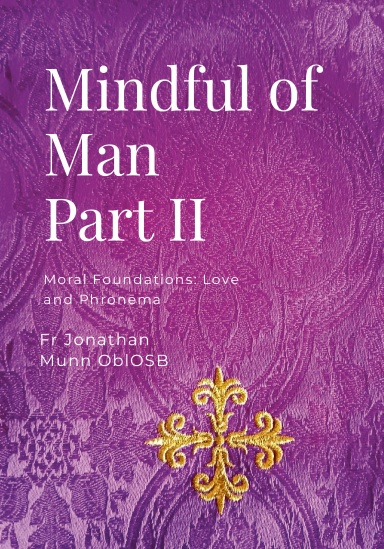
My friend Fr Jonathan Munn OblOSB, priest of the Anglican Catholic Church and an oblate of the Order of St Benedict, has now published the second part of his Mindful of Man, under the subtitle Moral Foundations: Love and Phronēma, and I had the honour of writing its foreword. It is published for the Anglican Catholic Church, Diocese of the United Kingdom, and may be ordered from Lulu.
The argument
Fr Munn begins where a great deal of modern moral argument now ends, with disagreement. Christians stand on both sides of the questions that most divide Western societies, and he traces the division not to the questions themselves but to differing accounts of God, of man and of love. His own answer is that morality is objective because goodness is God’s own nature, and that it can no more be detached from a simple and unchanging God than, in his phrase, one could extract the colour from red. He meets the Euthyphro dilemma and Mackie’s argument from queerness on that ground, and argues that the moral act, rightly understood, is an ikon of the life of the Trinity.
Against the doctrine of total depravity he holds that the image of God in man is marred rather than destroyed; that original sin is an inherited state of separation rather than inherited guilt, a point on which he prefers St John Chrysostom to St Augustine; and that grace may be resisted, so that salvation is a work in which God and the human will co-operate.
The centre of the book is its definition of love as “the will to perfection of the beloved in God”, which Fr Munn takes apart phrase by phrase, and its account of the phronēma, the mind of Christ. The word is St Paul’s. Fr Munn means by it being like-minded with Christ in His humanity: a mind that belongs to the Church corporately before it belongs to any one of us, and through which Christ’s will for the perfection of the beloved is carried into the life of the believer. It is acquired, he argues, chiefly by the cultivation of prudence. He then reads Anglican Catholicism as the natural meeting of three cords: the Orthodox understanding of salvation as theosis, the Roman Catholic conviction that right belief informs right practice, and the Anglican conviction that practice, experience and reason inform belief.
The last third of the book asks how such a mind is to be acquired in a secular world. Political philosophy, Fr Munn argues, rests on moral philosophy, and moral philosophy on an account of man; the expressive individualism and critical theories of recent decades follow from an anthropology loosed from natural law, and the remedy lies in the cardinal and theological virtues, with love as their form. A reading of the High Priestly Prayer of St John xvii follows, and then a long chapter on the family, modelled on the Benedictine house, as the pattern of Christian polity. The Church, he concludes, is a family whose language is liturgy and sacrament.
Readers need not share every conclusion to profit from an argument so carefully made and so widely read, in the Fathers, in St Thomas, and in the Anglican divines from Hooker to Kenneth Kirk and Mascall. This is the second of three parts, and the third will turn to particular moral acts and the degrees of sin. Pro Fide Press was founded in part to bring forward the work of colleagues whose scholarship deserves a wider readership, and I am glad to begin with this one.
Fr Jonathan Munn OblOSB, Mindful of Man, Part II: Moral Foundations: Love and Phronēma (Anglican Catholic Church, Diocese of the United Kingdom, 2026), hardback, 270 pp., with a foreword by Craig Paterson. Available from Lulu.
